The AI Classroom Has Arrived: Punjab Sets a New Benchmark for Indian Education
For years, Artificial Intelligence has been viewed as a skill reserved for engineers, data scientists, and technology professionals. But what if AI became as fundamental as Mathematics, Science, or English?
Punjab has taken a bold step in that direction by becoming the first state in India to introduce Artificial Intelligence as a mainstream subject for students from Classes I to XII. While the announcement may seem like another education policy update, it signals something much bigger: India is beginning to prepare its next generation for an AI-first world.
The question is no longer whether students should learn AI. The real question is whether other states can afford to wait.
AI Is Becoming the New Digital Literacy
Twenty years ago, computer education focused on typing, Microsoft Office, and internet basics. Today, digital literacy has evolved far beyond operating a computer.
Students entering the workforce over the next decade will collaborate with AI tools, automate repetitive tasks, analyze data, create digital content, and solve problems using intelligent technologies. Understanding how AI works will become as important as understanding how to search the internet or use a smartphone.
Punjab’s initiative recognizes that AI is not simply another technology subject. It is becoming a foundational skill for future careers.
Why Introducing AI From Class 1 Matters
One of the most significant aspects of Punjab’s programme is its phased approach.
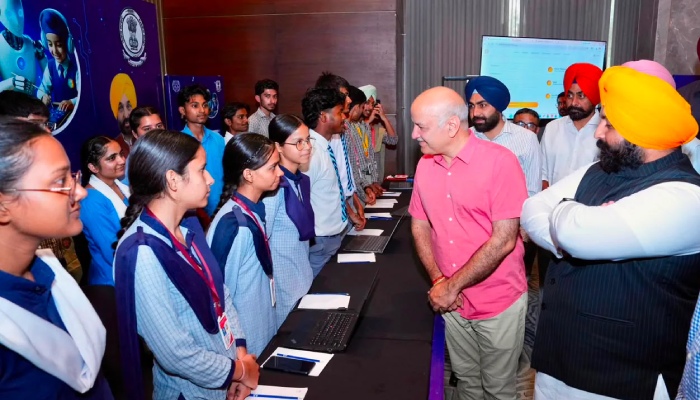
Students in Classes VIII to XII will first learn AI through Computer Science, using live online classes, recorded lessons, project-based learning, continuous assessments, and a dedicated Learning Management System. The second phase will introduce age-appropriate AI concepts to children from Classes I to VII, ensuring that younger learners develop curiosity and digital thinking from an early age.
This gradual progression mirrors how students traditionally learn mathematics: starting with simple concepts before advancing to more complex applications.
By introducing AI at different learning stages, education shifts from memorizing technology to understanding how it can be applied responsibly and creatively.
Preparing Students for Jobs That Don’t Exist Yet
According to multiple global workforce studies, many of the careers today’s students will pursue have not yet been fully defined.
Roles such as AI Product Manager, Prompt Engineer, AI Ethics Specialist, Machine Learning Operations Engineer, and Autonomous Systems Designer barely existed a few years ago. As AI continues to reshape industries, entirely new professions will emerge.
Teaching Artificial Intelligence in schools is therefore less about coding and more about preparing students to think critically, solve complex problems, and adapt to continuous technological change.
AI Education Is More Than Learning to Code
A common misconception is that AI education is only relevant for students interested in engineering or computer science.
In reality, Artificial Intelligence is becoming a cross-disciplinary skill.
Future doctors may use AI to improve diagnoses. Farmers could rely on AI-powered insights to increase crop yields. Teachers may personalize lessons using intelligent learning platforms. Designers, marketers, lawyers, architects, and entrepreneurs are already using AI to improve productivity and decision-making.
Teaching AI in schools ensures students understand not only how to use these tools but also when to question their outputs, identify bias, protect privacy, and make ethical decisions.
These are life skills, not just technical skills.
Building an AI-Ready Education Ecosystem
Punjab’s initiative extends beyond introducing a new subject.
The programme includes live instruction, recorded learning resources, project-based activities, continuous assessments, and a Learning Management System to support structured learning. It also brings together technology partners to strengthen AI literacy, teacher training, innovation, and workforce readiness.
This ecosystem approach is important because successful AI education depends as much on trained educators and accessible learning resources as it does on curriculum design.
Why Other States Should Pay Attention
Artificial Intelligence is already transforming industries including healthcare, banking, manufacturing, retail, agriculture, hospitality, and education.
The students entering classrooms today will graduate into workplaces where AI is embedded in everyday decision-making.
States that begin investing in AI education today are not simply teaching another subject. They are investing in economic competitiveness, digital innovation, and workforce readiness for the coming decades.
Punjab’s decision could become a blueprint for education systems across India.
Challenges That Must Be Addressed
Introducing AI into classrooms is an important milestone, but its long-term success will depend on thoughtful execution.
Schools will need reliable digital infrastructure, trained teachers, updated learning resources, and practical classroom activities that make AI concepts meaningful for students of different age groups. Equally important is ensuring that students develop responsible AI habits by understanding ethics, privacy, bias, and critical thinking alongside technical knowledge.
Without these foundations, AI education risks becoming theoretical rather than transformational.
The Future of Education Is Already Here
Artificial Intelligence is no longer a technology of the future. It is becoming part of how people learn, work, communicate, and solve problems every day.
Punjab’s decision to introduce AI education from Classes I to XII is more than a curriculum update. It represents a shift in how education prepares students for a rapidly changing world.
As industries continue to embrace AI, schools must evolve alongside them.
The classrooms that teach students how to work with Artificial Intelligence today will produce the innovators, entrepreneurs, researchers, and leaders who shape tomorrow.
The future of education won’t be defined by whether students learn AI.
It will be defined by how early they begin.